Problem Definition
The technical, operational, and behavioral skills possessed by employees in organizations are often not measured systematically and are evaluated based on personal observations and managerial intuitions. This situation causes;
- Critical competencies remaining invisible,
- Incorrect role assignments,
- Training investments yielding low returns,
- Late realization of organizational risks
Therefore, managing employee skills is not just an HR issue; it is a strategic engineering problem that directly affects operational continuity and corporate performance.
Why Was the Analysis Conducted?
Employee competencies are not an area that can be evaluated accurately by eye. Therefore, the analysis was designed on clear, measurable, and comparable criteria instead of intuitive judgments.
In this context;
- Competencies were divided into technical, operational, analytical, and behavioral dimensions,
- A level definition from 1 to 5 was made for each competency,
- Role-based minimum competency levels were defined.
Thanks to this approach, the problem was removed from being open to interpretation, digitized, and made traceable.
Applied Method
In the analysis process conducted by the expert team:
- Required competency sets for all roles were defined,
- Employees were evaluated according to these sets,
- Current level and target level were compared,
- Critical skill gaps were identified.
Evaluations were clarified through cross-validation by managers, process owners, and HR.
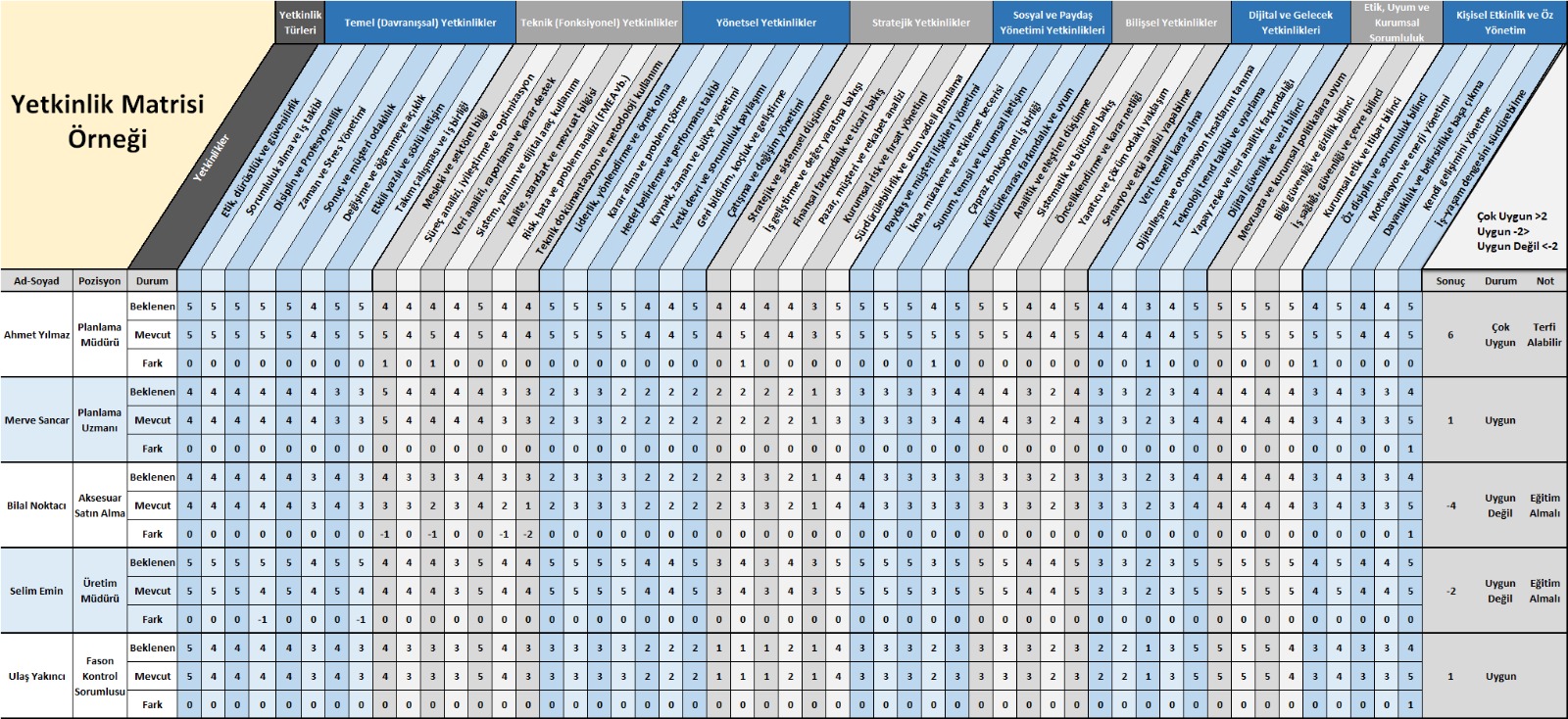
Employee Skill Matrix Visual
Findings
Analysis outputs from the sample can reveal the following critical results:
- It was observed that most of the evaluated positions generally meet role expectations, and only some roles have a development need close to the target,
- The main problem for roles in the "Not Suitable - Needs Training" category is not inadequacy; it is that the target level has not yet been reached in certain areas,
- It is foreseen that compliance can be achieved in a short time with planned and targeted development programs for these roles,
- It is seen that the Planning Manager position is mature enough to be considered for higher-level responsibilities and broad spheres of influence in terms of its current competency level.
These findings show that the problem is not an individual but a structural competency management issue.
ISO 9001:2015
Definitive Solution to Competency Clause
Importance of the Study and Achievements
- Employee competencies became measurable for the first time.
- The actual competency map of the organization has become clear.
- Training and development investments have been made targeted.
- Promotion, backing up, and role assignment decisions have become data-driven.
Competency management does not only mean human resource planning; it means operational continuity, quality, and competitiveness.
For more information, you can visit our Operational Excellence service page.