Problem Definition
In production support and control processes, the number of staff is often determined according to habits or past practices, and the actual workload and capacity needs are not systematically measured. This situation creates;
- Excessive or insufficient staff usage,
- Unbalanced workload distribution,
- Hidden overtime need,
- Operational inefficiency
Therefore, determining norm staffing is not merely a human resources issue; it is a strategic engineering problem with direct impacts on cost, capacity, and service level.
Why Was the Analysis Conducted?
Norm staffing needs are not an area that can be accurately determined by eye. Therefore, the analysis was designed based on measurable workload, time, and output metrics instead of intuitive judgments.
In this context:
- The monthly maximum needed meter to be controlled was defined,
- Working day and shift durations were standardized,
- Hourly control capacity per person was measured,
- Over / under staffing scenarios were created with variance analyses.
Thanks to this approach, the norm staffing need was removed from being open to interpretation and made numerical, trackable, and manageable.
Applied Method
In the analysis process conducted by the expert team:
- The maximum meter to be controlled according to months was estimated,
- Working day and daily effective working time were defined,
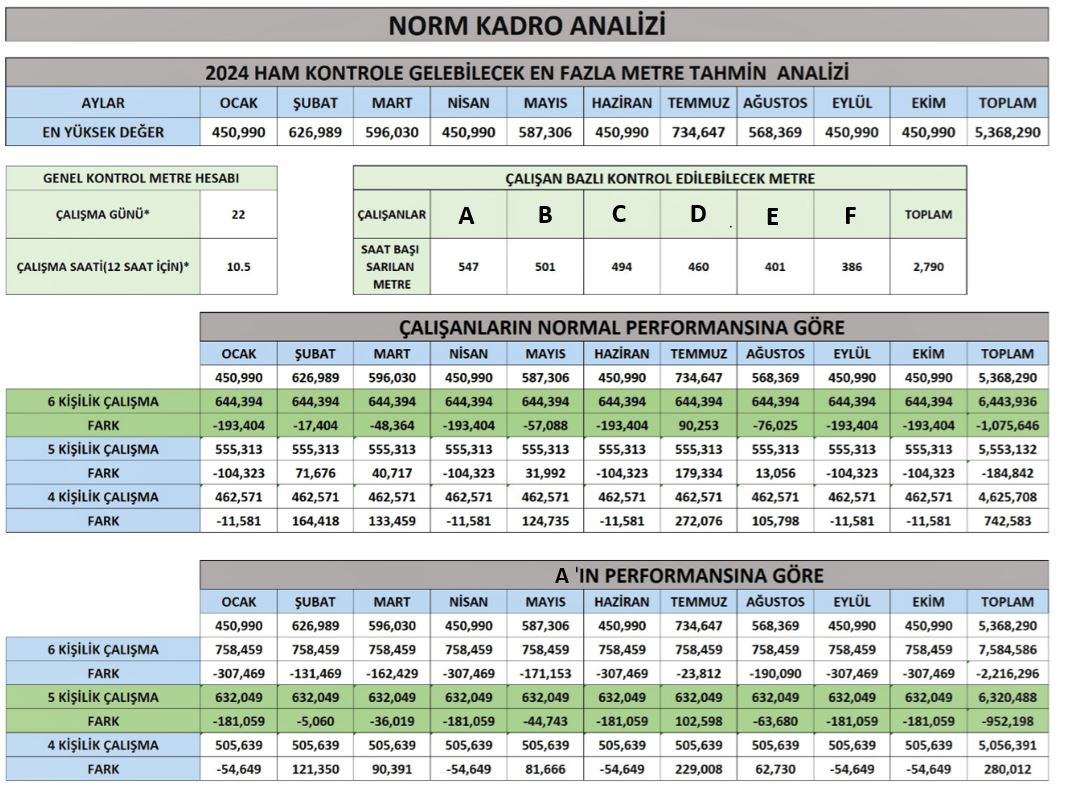
- Employee-based hourly control capacities (A, B, C, D, E, F) were measured,
- Staffing scenarios of 4, 5, and 6 people were simulated,
- The capacity-need variance was calculated for each scenario.
All calculations were shown in the Norm Staffing Analysis report.
Norm Staffing Analysis Graphs
Via the "Norm Staffing Analysis" screen developed on an Excel basis;
- Monthly maximum need,
- Staffing scenarios (4-5-6 people),
- Variance analyses,
- Employee performance-based scenarios
have been made trackable together.
Findings
Analysis outputs revealed the following critical results:
- A systematic excess capacity occurred in a staff of 6 people,
- A capacity gap occurred in certain months in a staff of 4 people,
- The staff of 5 people was the closest structure to optimal balance in many months,
- It was determined that individual performance differences significantly affect total capacity.
These findings show that staffing needs should be managed not as a fixed but as a dynamic structure based on workload and performance.
4 – 5 – 6
Staff Simulation
A – F
Performance Variance
Importance of the Study and Achievements
With this study:
- The norm staffing need was defined analytically for the first time.
- Hidden costs caused by over or under staffing have become visible.
- Monthly and periodic staffing planning has become possible.
- The effect of performance differences on capacity became clear.
- Operational decisions were made data-driven.
For more information, you can visit our Operational Excellence service page.