Problem Definition
Demand forecasting processes are often carried out based on past experience and intuitive evaluations, which causes significant variances in production, purchasing, and inventory planning. This situation creates;
- Overproduction or inventory accumulation,
- Inventory shortages and deadline risks,
- Imbalance in capacity planning,
- Tied-up capital and cost increase
Therefore, demand forecasting is not merely a planning activity; it is a strategic engineering problem with direct impacts on operational efficiency, financial performance, and customer service level.
Why Was the Analysis Conducted?
Demand uncertainty is not an area that can be managed by eye. Therefore, the analysis was designed based on measurable variance, accuracy, and scenario metrics instead of intuitive judgments.
In this context:
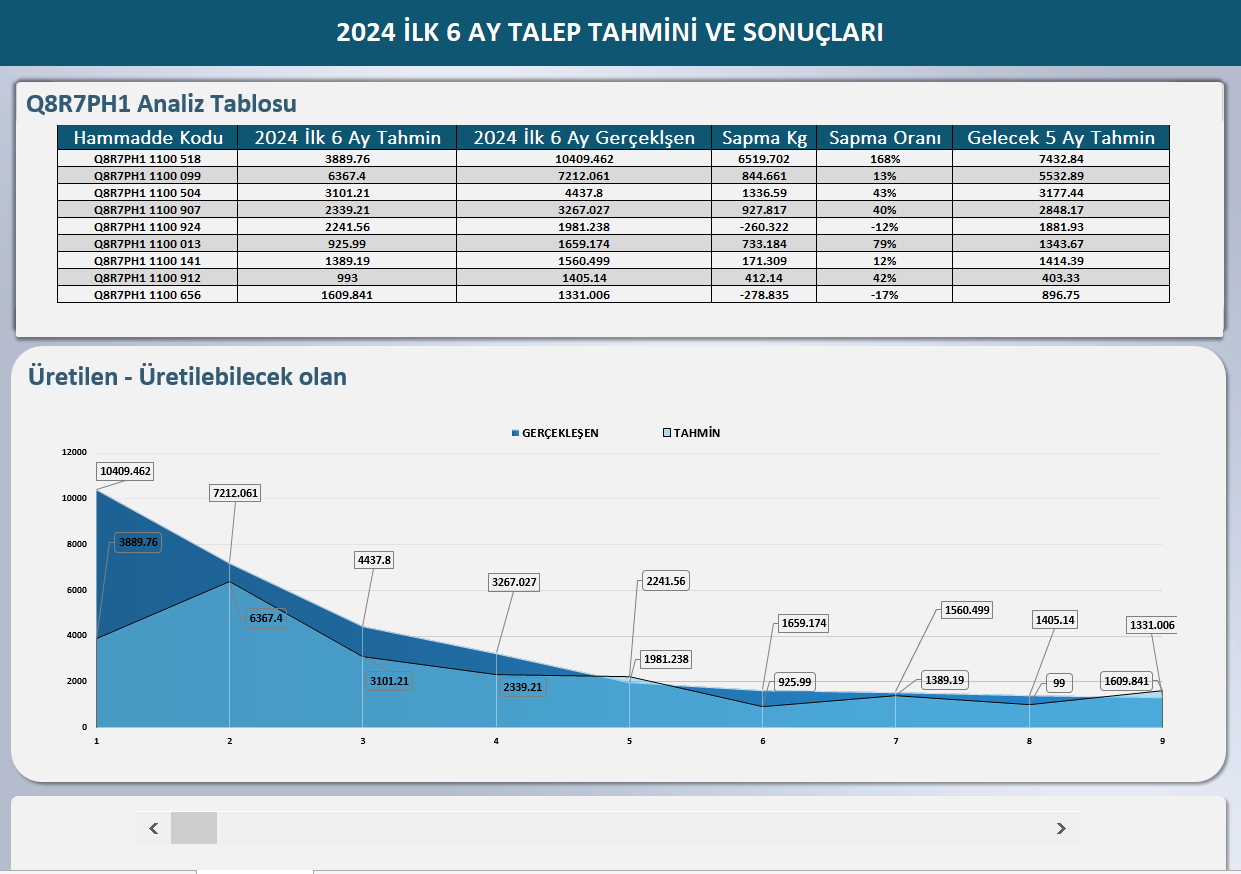
- Forecasted and actual values were systematically compared,
- Variance amount (kg) and variance rate (%) were calculated,
- Raw material-based uncertainty profiles were extracted,
- Forecast model performance was measured objectively.
Thanks to this approach, the forecasting process was removed from being open to interpretation and made numerical and manageable.
Applied Method
In the analysis process conducted by the expert team:
- 6-month forecasted and actual data were collected on a raw material code basis,
- Absolute and proportional variances were calculated,
- Variance trends were analyzed graphically,
- Revised forecasts were created for items with high variance.
The results were visualized in a Dashboard report made in Excel.
Findings
Analysis outputs revealed the following critical results:
- Color-based needs of a large portion of raw materials can be forecasted,
- It has been determined that pre-production can be done with the available data during company holidays or when production is low.
These findings show that the problem is not isolated; it is a structural forecasting and planning issue.
22 Tons
Amount that can be Pre-produced
8 Tons
Overproduced Amount
Importance of the Study and Achievements
With this study:
- Forecast accuracy was measured systematically for the first time.
- It was determined which items can be forecasted.
- Idle periods were converted into profit by pre-producing, and efficiency was achieved.
- Overproduced items were consumed in the following 6th month.
- Inventory and deadline risks were reduced.
Demand forecasting is not only the question of 'what will we sell'; it is the foundation of the questions of how much we will produce, when we will produce, and how much we will tie up.
To optimize your capacity, you can visit our Operational Excellence service page.